At the executive level, a successful workplace project is measured by certainty – certainty of cost, programme, quality and risk control.
When a project delivers on time, within budget and without operational disruption, it can appear straightforward. But smooth delivery is rarely the result of good fortune. It is the outcome of early integration, disciplined coordination and deliberate risk mitigation.
The true value of an integrated Design & Build model lies in what happens before site mobilization.
Alignment From the Start
In traditional delivery models, design and construction operate in silos. Misalignment between intent and execution often surfaces late – in the form of variations, delays or budget exposure.
An integrated Design & Build approach removes that fragmentation.
By aligning design, engineering, procurement and construction teams from the outset, feasibility is tested early. Buildability is reviewed in parallel with design development. Costs are validated continuously. Compliance and authority requirements are anticipated, not reacted to.
This reduces uncertainty.
For leadership teams, this means fewer surprises during delivery and stronger control over capital expenditure.
Risk Is Managed Before It Materialises
Risk in workplace projects rarely announces itself loudly. It emerges quietly – through coordination gaps, unclear scope boundaries, incomplete authority submissions or late-stage material changes.
Integrated delivery is designed to address these risks upstream.
Through early-stage technical reviews, structured coordination workshops and transparent cost modelling, potential conflicts are identified before they escalate into programme delays or commercial disputes.
The impact is tangible:
- Reduced change orders
- Greater cost predictability
- Improved schedule integrity
- Clearer accountability across stakeholders
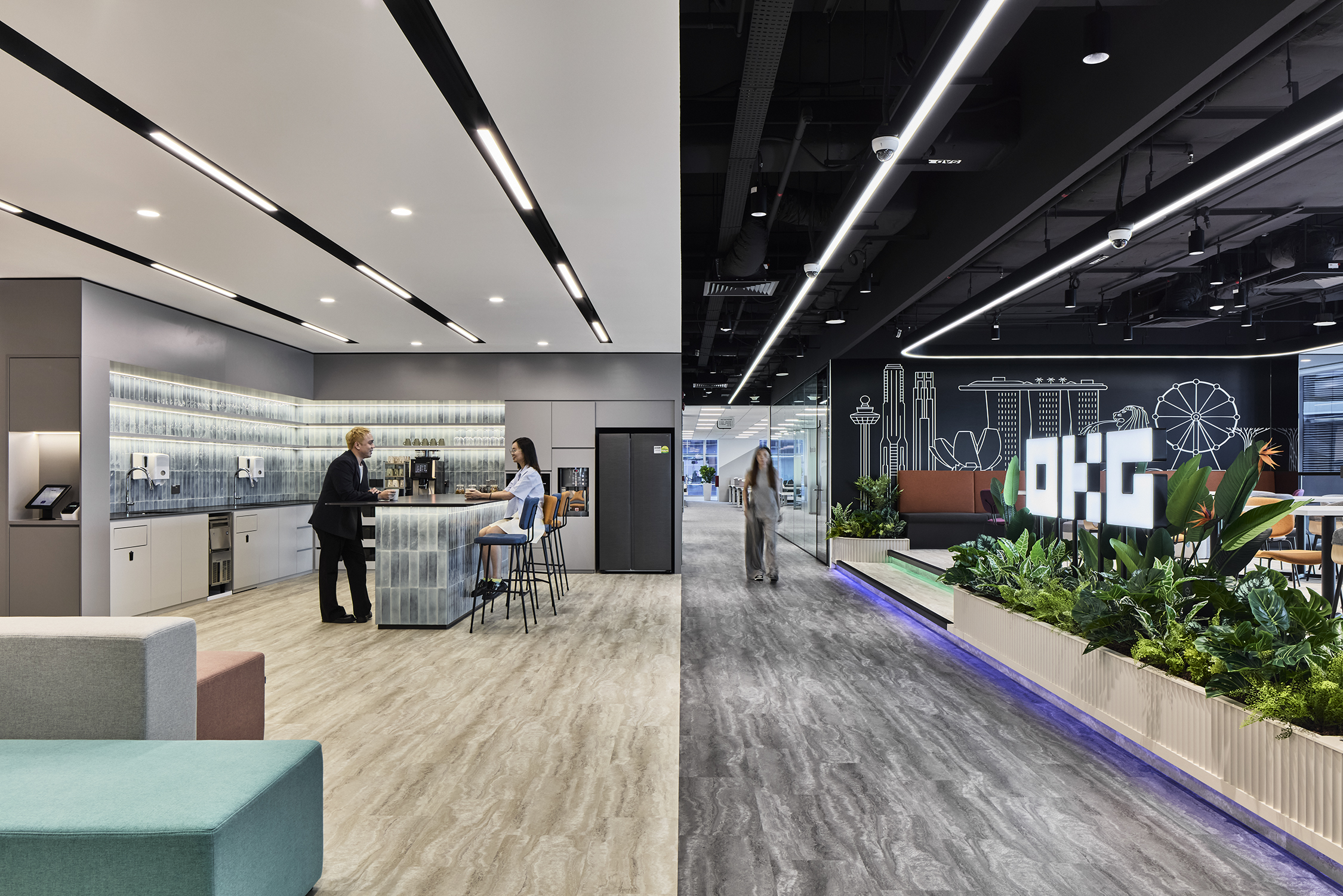
For OKG Singapore, specific operational requirements were embedded from the very start of design development. As an integrated designer and builder, we apply construction expertise at the design stage – identifying buildability, cost, and future-proofing considerations early. Unlike traditional fragmented approaches, where issues often surface only during construction, early integration helps prevent delays, variations and unexpected costs.
Governance and Accountability Strengthened
For executive sponsors, governance matters as much as design quality.
Within this integrated structure, project teams are organized with clear governance layers and escalation pathways, typically anchored by senior company leadership. Because design and construction sit within a single organization, issues do not move across multiple external parties before resolution. Instead, they are escalated internally to leadership with the authority to make timely decisions and coordinate the necessary response.
For clients, this reinforces the value of a single point of responsibility. Rather than managing fragmented accountability across multiple parties, executive sponsors have confidence that challenges will be addressed within one accountable structure – enabling faster resolution, clearer ownership and stronger control over project outcomes.
Programme Certainty and Business Continuity
In many workplace projects, time is not merely a schedule metric – it is a business risk.
Delays can affect lease transitions, regulatory commitments, operational readiness and reputational standing. Integrated planning aligns procurement strategy, construction sequencing and authority approvals early in the lifecycle, reducing exposure to programme drift.
Where projects are delivered in live environments, phasing and mitigation strategies are embedded into the delivery plan from day one – protecting ongoing operations and stakeholder experience. In a time-sensitive relocation, parallel design validation and authority submission reduced approval lead time by 20%, safeguarding business continuity.
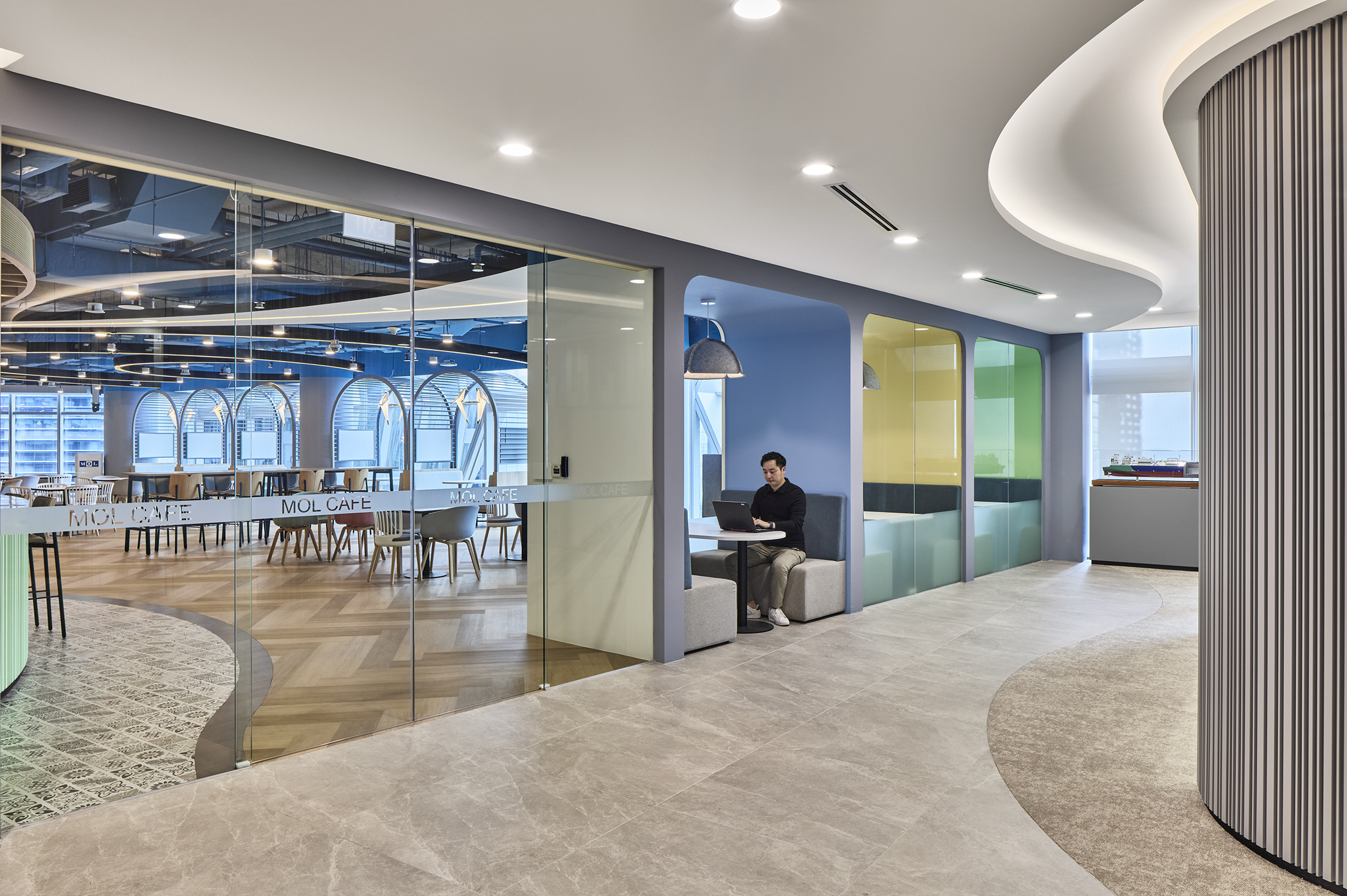
For MOL Group, we carried out addition and alteration works to their existing workspace to accommodate a growing workforce. Having completed their original office fit-out, we understood their floor plate, infrastructure and operational needs – allowing us to plan the live phasing works carefully from the onset without impacting their day-to-day operations.
For executive leadership, this translates to confidence that the project will not disrupt the broader business agenda.
Beyond Completion: Performance as the True Benchmark
Completion is not the ultimate measure of success. Performance is.
An integrated partner remains engaged beyond handover – ensuring systems are calibrated, IAQ targets verified and operational adjustments made where necessary. The objective is not simply to deliver a space that looks complete but one that performs reliably from day one.
Because capital investment in workplace transformation must deliver measurable return – through productivity, employee experience, operational efficiency and long-term asset value.
Strategic Value, Not Just Project Delivery
Integrated Design & Build is not about convenience. It is about control.
- It creates alignment between vision and execution.
- It strengthens financial predictability.
- It reduces operational risk.
- It provides leadership with clarity and confidence throughout the project lifecycle.
The hidden value is not found in finishes or visual impact – it is found in the disciplined integration that makes those outcomes possible.
When a project feels seamless, it is because the complexity was managed early, strategically, and deliberately.
And that is where true value lies.